Case study 03 — Property intelligence platform
PropTrader AVM
A valuation number on its own is an assertion. What makes one useful is the reasoning underneath it: which comparables, which infrastructure change, which rate forecast, and how much each is worth. PropTrader is built around exposing that reasoning rather than hiding it behind a figure.
- Next.js 16
- TypeScript
- Fastify
- Supabase
- Vertex AI
- RentCast

The problem
Property valuation tools give you a number and no way to interrogate it. Owners with more than one property have no single view of what they hold, and no way to ask what happens to it if rates move two points or regional demand turns.
What we built
A guided flow takes an address, collects specifications, compiles a valuation and reveals a property passport. Behind it the system scouts comparables, scans municipal registers, loads infrastructure deltas and builds a ten-year Monte Carlo valuation curve. From there the property joins a portfolio terminal, and both can be stress-tested against macro scenarios.
How it works
From an address to a property passport
Four steps: enter the address, add specifications by typing or by voice, compile the valuation, and reveal the passport. The compile step shows its work rather than a spinner, scouting comparables, scanning municipal registers, loading infrastructure deltas, building the projection.
Valuation drivers priced individually
The valuation panel lists what is moving the number, a metro line expansion, corporate migration into the area, an interest-rate cut forecast, and attaches an appraisal lift in currency and percentage to each. The figure becomes a position you can argue with rather than accept.
A portfolio read as one balance sheet
Multiple properties roll up into a live real-estate balance sheet: total portfolio value converted at live forex rates, a twelve-month growth chart, and per-property cards underneath.
Scenario-based valuation
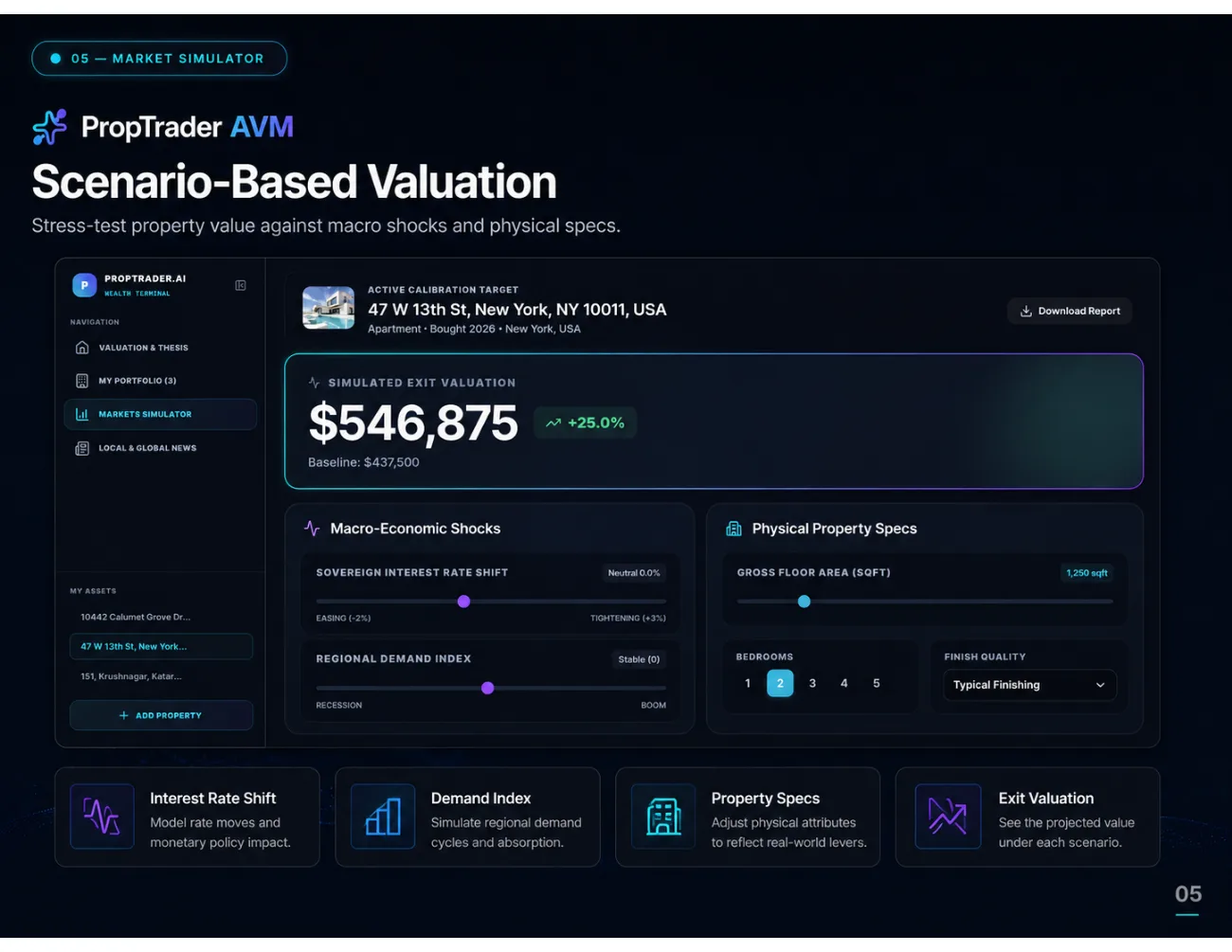
The markets simulator stress-tests a property against a sovereign interest rate shift from two points of easing to three of tightening, and a regional demand index from recession to boom. Physical specifications, gross floor area, bedrooms, finish quality, move on the same panel, and the output is a simulated exit valuation against the baseline.
Market intelligence with a thread attached
A curated news feed carries an AI insight per article and a discussion thread, so a market read has somewhere to be discussed rather than being a static list of links.
Reports that leave the platform
Valuations and scenarios export as PDF appraisals, which is what makes the analysis usable in a conversation with a lender, a buyer or a co-investor.
In the product




Outcome
A valuation platform where the number arrives with its reasoning attached, a portfolio reads as one live position, and any of it can be stress-tested against a macro scenario and exported as an appraisal.